After a few months of collaborative work, the process of prototyping co-designed spaces for arts and well-being in a school from Cluj-Napoca, has entered the design phase, and we are happy to share with all the community the results of this phase.
Design of the intervention prototype, validation of the intervention project
In this phase, under the guidance of Urban Scale Interventions (UK) (the process facilitator) and Cluj Cultural Centre (mediator of the collaboration and interaction between different parties) the contributors, engaged since the beginning of the initiative and part of the Steering Committee, brought in the process their professional expertise, and worked in a collaborative manner to provide, in the end, the best experiential space for well-being for the beneficiaries.
Starting from the brief, defined after the needs assessment phase, the Urban Scale Interventions team prepared guidelines for the Steering Committee, which synthesize all the results from the previous phases and emphasize the expectations for the design phase and for the expected contribution of each specialist.
During this phase a series of visits to the school for the specialists involved in the process were organized, also workshops and discussions with school representatives took place in order to clarify the conceptual, administrative and practical aspects of the spaces that will be designed in the school.
Artists, landscapers, designers and architects contributed with a series of proposals that were integrated into several design concepts for indoor and outdoor spaces. Based on all these inputs and contributions, the Urban Scale Interventions team proposed two different integrated visions for the indoor space:
ROOM VISION #1 | THE ENCHANTED GARDEN

ROOM VISION #2 | MYSTERIOUS PLANET

The room proposals were subsequently presented and voted on by the direct beneficiaries of the initiative – the school representatives and students – and the Room Vision # 2 | MYSTERIOUS PLANET was selected to be implemented.
Who were the contributors to the design phase?
- Adela Hoble | University of Agricultural Sciences and Veterinary Medicine of Cluj-Napoca | Landscape Designer and Researcher
- Elisa Jurca | Architect
- Alin Tănasă | Artist / Maker | Blajin
- Tamás Márkos | Independent artist | Photographer / Musician / Educator
- Teodora Morar | Romanian Landscape Association | Landscape Designer and Researcher
- Simona Munteanu | Architect
What did the contributors propose in terms of well-being for the school space?
Tamás Márkos imagined a space where music is part of daily routine, where students have the opportunity to explore the well-being through the benefits of listening and creating music by themselves. As a musician, he proposed several musical instruments suitable for groups and individual musical experimenting. Some instruments proposed are:
Color Sounds Djembe Set

Percussion Starter Set

Ocean Drum Aquarium
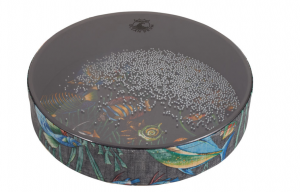
Rainbow Handbells

Alin Tănasă proposed a wooden utility wall, handmade by himself, which provides an exploratory approach for students. Entitled “The Playful Wall”, the concept proposed by Alin is a kit of a playful space for primary school students which includes: a wooden wall, adjustable shelves, sensorial boxes and hammocks. In this way, students can create and recreate their own space based on the immediate needs they identify at a certain moment.
”The Playful Wall” – concept and design by Alin Tănasă

Eliza Jurcă & Simona Munteanu, the two architects involved in the process, were responsible for transforming the imagined room vision # 2 | MYSTERIOUS PLANET into a physical space that could be explored by the students. They made the physical measurements and were studying all the possibilities to make the MYSTERIOUS PLANET room become a real, tangible space. Their final architectural plan is presented below.
MYSTERIOUS PLANET Room at Onisifor Ghibu High School – Architectural Plan proposed by Eliza Jurca & Simona Munteanu

On the other side, Adela Hoble & Teodora Morar, the landscape specialists involved in the process, oriented their efforts towards an integrated approach on various outdoor spaces of the school and proposed, after physical measurements and research, the landscape architecture for:
A green garden for creative activities – Landscape Proposal by Adela Hoble & Teodora Morar

A landmark for a school street view – Landscape Proposal by Adela Hoble & Teodora Morar

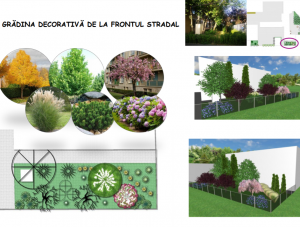
A decorative garden for a school street view – Landscape Proposal by Adela Hoble & Teodora Morar
A sensory garden for the school backyard – Landscape Proposal by Adela Hoble & Teodora Morar

As next steps, Cluj Cultural Centre, in collaboration with school representatives, architects, artists, landscape designers, local public authorities will proceed to the implementation of these design proposals for indoor spaces.
Art & Well-being space activity is initiated and coordinated by Cluj Cultural Centre within the interdisciplinary approach of the Art & Well-being project, co-funded by the Creative Europe Programme of European Union, and the Learning QUB program, financed by Botnar Foundation.